Networking and Network Resources in SleakOps
Understand the network architecture that SleakOps deploys in customer environments — how it is organized, how resources are protected, and how internal and external communication is enabled.
The network is designed to guarantee security, scalability, and high availability. It separates environments, protects sensitive data, and exposes services in a controlled and secure way.
1. Architecture Overview
SleakOps network infrastructure is built around these core components:
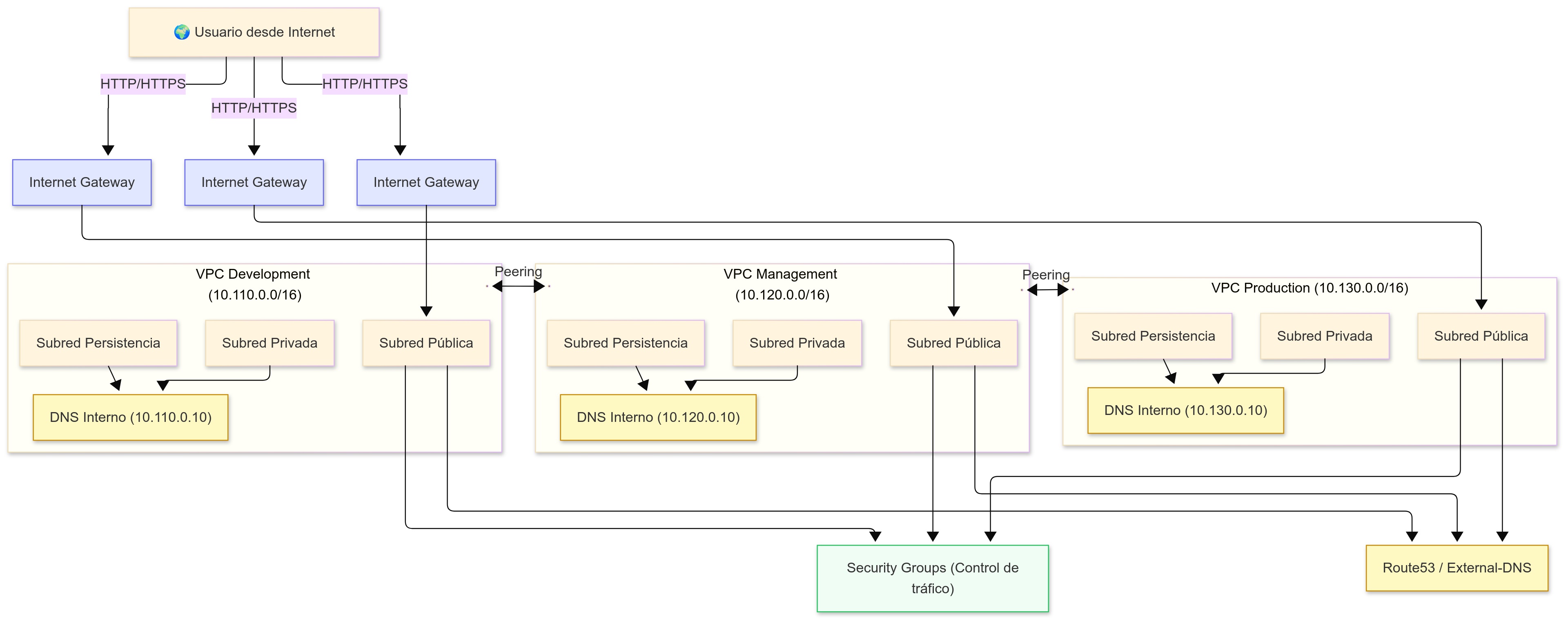
- VPC (Virtual Private Cloud): Segments the network by environment (management, production, development).
- Subnets: Separate traffic by function — public (internet-facing), private (restricted access, internet via NAT Gateway), and persistence (databases, storage).
- Internet Gateway: Enables communication between the VPC and the internet.
- Route Tables: Define traffic routes between subnets and to/from the internet.
- Security Groups: Virtual firewalls that control inbound and outbound traffic for resources.
- Internal DNS: Allows resources to communicate using names instead of IPs.
- External-DNS: A service running inside each EKS cluster that automatically manages public DNS records in Route53 for services exposed from the cluster.
2. Typical Communication Flow
- Access from the internet: A user accesses an exposed service (e.g., an API). Traffic reaches the Internet Gateway and is directed to the public subnet.
- Access control: The Security Group associated with the resource validates whether the connection is allowed.
- Internal communication: Internal services (in private or persistence subnets) communicate with each other using internal DNS, always governed by Security Group rules.
- Service exposure: If a service inside the Kubernetes cluster must be accessible from the internet, it is exposed through an Application Load Balancer — External-DNS then automatically registers the name in Route53.
This segmentation ensures that only necessary services are exposed and that sensitive data remains protected.
3. External-DNS and Route53
An automated solution manages public DNS records for deployed services, integrating the infrastructure with Route53. This makes services securely and simply accessible from the internet. External-DNS does not expose services directly — it automates the management of public DNS records for resources that are already exposed (for example, via an Application Load Balancer).
4. Inter-Environment Connectivity via VPC Peering
To allow controlled communication between environments (for example, between management and production), SleakOps explicitly configures VPC Peering connections between the VPCs of each environment.
A VPC Peering allows two VPCs to exchange internal traffic as if they were on the same network, without passing through the internet, NAT Gateway, or a VPN. It is a direct connection between two networks.

In addition to Internet Gateway access, SleakOps supports other connectivity mechanisms such as Pritunl VPN, NAT Gateway, and Transit Gateway, depending on the use case and the required level of isolation.
DNS Reference by Environment
| Environment | VPC DNS |
|---|---|
| DEV | 10.110.0.2 |
| MGT | 10.120.0.2 |
| PRD | 10.130.0.2 |